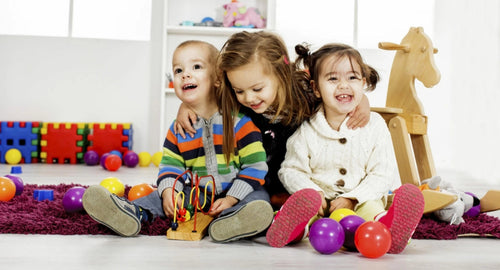
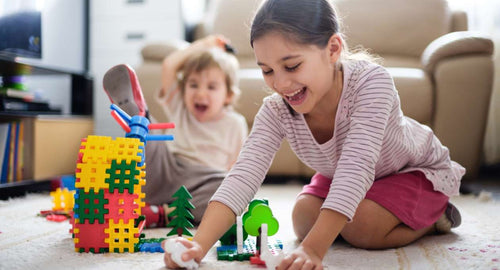
EQ development toys for a 6-year-old child not only serve as entertainment, but also as an important tool for children to learn how to understand and regulate their emotions. Are you looking for toys to help your child develop life skills, learn to share, cooperate, and become more thoughtful in daily interactions? Mykingdom will reveal the top EQ development toys for your beloved 6-year-old.
Why develop EQ in a 6-year-old through toys?
At age six, children begin a broader social journey, where the learning environment, teachers, friends, and situations are no longer confined to the family. This is also the time when emotional intelligence (EQ) needs to be nurtured properly, so that children know how to manage their emotions, communicate effectively, and build positive relationships.
With Mykingdom, toys are not just gifts for play; they are bridges for children to naturally and gently develop inner values.

Features of EQ development toys for a 6-year-old
An effective EQ development toy for a 6-year-old should encourage the child to:
-
Express and regulate emotions
-
Listen and empathize with others
-
Collaborate, resolve conflicts in group play
-
Develop patience and the ability to understand
These things cannot come from dry lectures; they come from truly meaningful and deeply engaging play experiences.
Suggestions for EQ development toys for a 6-year-old
Developing emotional intelligence (EQ) is an important part of a child’s growth journey. For a 6-year-old, suitable toys not only bring joy but also help them recognize, express, and regulate emotions, thereby building healthy social relationships. Below are selected toy suggestions to help your child develop EQ naturally and effectively.
1. Role-playing toys
Role-playing toys are the simplest doorway for children to enter the emotional world of adults. When taking on roles such as a doctor, chef, hair stylist, or a shop assistant, cashier in a supermarket, the child experiences real-life situations, thereby developing basic social skills.
For example, when the child plays the doctor, they learn to care for others; or when cooking with a friend, they practice cooperation and sharing. Mock setups like a BBQ grill stand or a pet dentist playset are wonderful options trusted by many parents.

2. Scenario-based role-playing games
Unlike plain role playing, scripted role-playing games present more complex situations that require deeper interaction. The child can build a story with friends, resolve conflicts, or engage in dialogue according to a predefined role. This helps them become acquainted with challenging emotions such as sadness, anger, or disappointment, while learning to regulate them.
Parents: Use dolls, plush toys, or small models like a fire engine to create a simple, readily available setup at Mykingdom to spark your child’s imagination.

3. Emotion toy set
Young children often struggle to name their emotions accurately. Emotion toy sets, such as expressive-face cards, magnetic emotion boards, or facial sticker sets, are powerful tools to help children clearly identify differences between happiness, sadness, worry, and anger. This is a crucial starting step for children to understand and regulate their emotions in the right moment. Parents can pair play with open-ended questions like “What do you think this character is feeling?” to encourage empathy in children.
4. Interactive games
Interactive games cannot be overlooked when talking about EQ development toys for a 6-year-old. Games like Mini Monopoly, group-building games, or simple family board games will require the child to wait for their turn and learn to accept winning or losing gracefully. These games teach children to stay calm when they fail, to praise the winner, and to build strategies to improve. Especially for energetic kids, group interactive games are highly effective in regulating behavior.

5. Construction toys
Many may be surprised to learn that construction toys are also a wonderful tool for developing EQ. When a child eagerly completes a LEGO model or a wooden jigsaw, they not only practice patience and planning but also learn to face failure and find solutions. Especially when playing with friends or siblings, this is when EQ is most strongly developed: they learn to ask for opinions, accept feedback, and cooperate to achieve a common goal.

Tips for choosing the right EQ development toys
To ensure effectiveness and safety when selecting EQ development toys for a 6-year-old, parents should note the following:
-
Origin and safe materials: Prioritize toys with clear origins and made from non-toxic materials. This not only protects the child’s health but also gives parents peace of mind.
-
Age- and ability-appropriate: Choose toys with a suitable level of difficulty, not too easy to bore the child or too hard to discourage them. A well-suited toy will stimulate curiosity and the child’s capacity to explore.
-
Encouraging social interaction: The ideal toys should be bridges helping the child connect with the outside world, rather than just immersing in their own world. Toys that encourage interaction will help the child develop communication and teamwork skills.
-
Diversify play experiences: Don’t limit the child to one type of toy. Combine various formats such as construction, role playing, active play, or storytelling to provide rich experiences that help the child develop all aspects of EQ.
Children do not learn EQ from theory. They learn from moments of play, from timely questions you ask, from seeing friends laugh or cry. And EQ development toys for a 6-year-old are the bridge and the vehicle for those emotional lessons to be planted naturally.
See more:
-
Top 5 construction toys for a 6-year-old to help develop logical thinking
-
Top 10 thinking-development toys for 6-year-olds that parents should choose
Hãy cùng Mykingdom khám phá những bộ đồ chơi đồ chơi phát triển EQ cho bé 6 tuổi ý nghĩa và gần gũi để hành trình trưởng thành của con đầy sắc màu yêu thương và cảm thông. Bạn có thể bắt đầu bằng việc tìm kiếm ngay hôm nay trên mykingdom.com.vn – nơi không chỉ có đồ chơi, mà còn có những câu chuyện đồng hành cùng sự phát triển của bé.