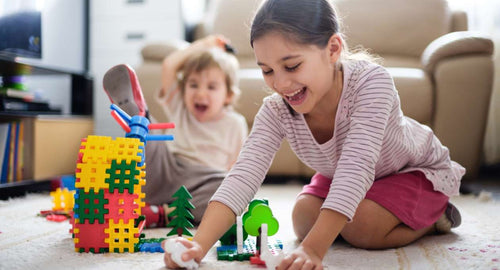
How much toy shopping is enough for your child is a question that many parents have wondered, especially when faced with a forest of colorful toys. In fact, buying the right amount matters more than buying a lot, and with just a little finesse it's enough for your child to play happily and learn well every day.
Less is more: The easy-to-apply golden rule
In reality, having too many toys will distract children and quickly bore them due to information overload. Instead of buying a mountain of toys, parents should keep only about 3–5 items for the child to use at one time.
The secret here is rotation: Every 1–2 weeks, parents should put away the old toys and swap in a few other items that had been hidden before. This approach not only creates a sense of novelty but also helps children learn to focus deeply and explore the full functionality of each toy.

Golden criteria for choosing toys for your child
To answer the question of how much toy buying is enough, we should focus on quality and usefulness rather than quantity.
Safety first
No matter how nice a toy looks, if it's not safe, skip it. When choosing, pay attention to a size larger than the child's mouth, avoid small parts that can come loose. Toys with batteries should be secure, with a tight seal. The surface should be smooth, with no sharp edges. Safe materials with clear origins will help parents feel more at ease as their child plays every day.
Just paying attention to these points, selecting toys becomes much easier.
Choose by developmental stage
Each stage of development requires different experiences. Toys appropriate for the child's age help stimulate thinking and natural movement.
-
Infants from birth to 6 months: Prioritize toys that stimulate the senses, such as rattles, bells, an A-frame shelf, or soft teething toys.
-
Children aged 1–3 years: This is when they are active and curious. Large building sets, push-along ride-on toys, play dough, or role-play toys (doctor, cooking) are highly suitable.
Prioritize open-ended toys
Having too many toys at once can easily distract a child. Instead, prioritize open-ended toys—things that let children explore many different ways to play. For example, building sets, wooden blocks, play dough, or construction kits. One toy that can be played today in different ways tomorrow is both economical and fosters imagination.
These kinds of toys are also generally more durable, last longer, and are suitable for many developmental stages.

Don't forget the interactive aspect
Toys gain meaning when there is interaction. Items that can be played together, such as construction sets, traditional games, or role-playing toys, help children learn sharing, communication, and connection. The moments of sitting down to play and talk together can be even more precious than the toy itself.
Many parents share that just a few simple toys, played together regularly, can still make the child very happy and more connected.

The act of buying toys for your child how much is enough actually lies in how we create beautiful memories with our child. A good toy is one that is tied to your child's laughter and daily progress.
We hope the above tips help parents feel more at ease when choosing gifts for their child. Would you like MyKingdom to suggest a list of the hottest open-ended toys to help your child develop intellectually? Contact us today!
See more: