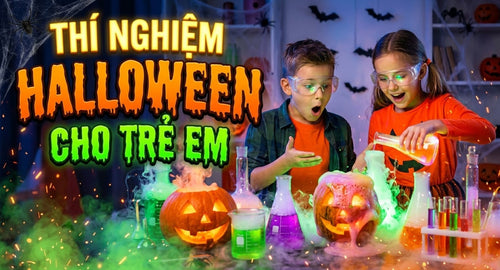
Besides the usual Halloween makeup activities, this year's festive season will be even more fun as a small kitchen becomes an exciting science space.
The Halloween experiments for kids not only bring surprising fun but also spark their natural curiosity. Through fizzy bubbles and vivid color swirls, your child can observe real scientific phenomena right at home with mom and dad.
Guidelines for choosing Halloween science activities for kids by age
To ensure the activities run smoothly and safely, parents should choose experiments that fit their child’s abilities:
-
Preschoolers (3–5 years): Prioritize activities that involve color observation, texture sensing, or simple static electricity phenomena. At this age, adults prepare the materials and perform the main steps, while the child participates by observing and assisting with simple tasks such as sprinkling candies or tapping objects lightly.
-
Primary school children (6–10 years): They can measure vinegar, baking soda, attach balloons, or make predictions about the CO2 gas reaction under the careful guidance and supervision of adults.
Top 8 Halloween experiments for kids that are very easy to do with readily available ingredients
Halloween Pumpkin Volcano Eruption Experiment
Mom and child are surely familiar with the volcano eruption experiment using clay.
But this Halloween season, upgrade it to a magical pumpkin version where foam will foam out from the eyes and mouth of the pumpkin itself, creating a scene that is both whimsical and surprising for your little one!
Ingredients:
-
1 small pumpkin hollowed out (or a paper cup drawn with a pumpkin face)
-
2–3 teaspoons baking soda, 50ml vinegar
-
1 teaspoon dish soap, a few drops of food coloring (orange or red)
-
1 deep plastic tray.
Instructions:
-
Place the pumpkin in the center of the plastic tray. (Tip: Place a plastic cup inside the pumpkin to keep ingredients from spilling out through the eye and mouth gaps before the reaction starts.)
-
Add baking soda, dish soap and food coloring into the pumpkin cavity.
-
An adult slowly pours vinegar and reminds the child to maintain a safe viewing distance.

Science tip
Acetic acid in vinegar reacts with sodium bicarbonate in baking soda to release carbon dioxide (CO2).
Dish soap helps trap the gas inside the soap bubbles, forming a foam that spills out from the eyes and mouth of the pumpkin. This Halloween pumpkin eruption experiment lets the child directly observe the gas-producing reaction through the dynamic foam.
To let your child enjoy multiple volcano eruptions without collecting a lot of ingredients, choose the STEAM RTNGVOLCANO2 Volcano Eruption Experiment Kit from Mykingdom, official.

The Ghostly Hand That Puffs Up
Ingredients:
-
1 thin rubber glove
-
1 plastic cup, 50ml vinegar
-
2 teaspoons baking soda
-
Marker, small rubber band.
Instructions:
-
Draw claw marks on the glove with a marker. Pour vinegar into the cup (place the cup on a sturdy flat tray).
-
Put the baking soda inside the fingers of the glove.
-
The adult helps cover the glove’s cuff over the cup mouth, using a rubber band to seal the edge, then have the child lift the glove upright so the powder falls into the vinegar.

Science tip
Vinegar reacts with baking soda to create CO2 gas. The gas increases pressure inside the glove, causing the rubber to expand and the fingers to puff up gradually.
Magic Water Bag Test: Not Poppable
Ingredients:
-
1 clear plastic zip bag
-
Water tinted with red or orange food coloring
-
3–4 sharpened wooden pencils
-
1 tray to catch underneath.
Instructions:
-
This activity is performed directly by an adult to ensure safety. Pour water into 2/3 of the bag and seal the bag.
-
An adult firmly holds the bag above the catch tray, gently and decisively pierces the bag with a pencil through both sides, and keeps the pencil on the bag’s side for the child to observe.

Science tip
The clear plastic bag (polyethylene) can deform around the pencil. When the pencil goes through the bag, the plastic film in contact with the pencil helps limit water from leaking out.
However, outcomes depend on the bag’s flexibility and the way it’s pierced; water may still leak if the bag is torn or the pencil edge is rough.
Paper Ghosts Flying with Static Electricity
Ingredients:
-
Thin tissue paper cut into small ghost shapes
-
1 balloon, a piece of wool fabric (or the child’s dry hair)
Instructions:
-
Success tip: Separate the tissue to obtain a single ultra-thin layer, cut into small ghost shapes about 2–3 cm, and place on a flat table.
-
Rub the balloon on hair or a wool sweater for about 30–40 seconds, then bring the balloon close to the paper (about 2–3 cm away).

Science tip:
When rubbed against wool, the balloon becomes charged. When the charged balloon is brought near, the static charges in the paper redistribute, causing the lightweight paper pieces to be attracted to the balloon and lifted off the table.
Note: The experiment works best in a dry space with low humidity.
The Spooky Lava Lamp
Ingredients:
-
1 clear plastic bottle about 500ml (or a clear rigid plastic cup)
-
Water, vegetable oil, effervescent tablets (like Alka-Seltzer)
-
Food coloring: green or orange/red
-
1 small flashlight (or phone flashlight)
-
1 oil-based marker/black marker
Instructions:
-
The child gets to pretend to be a little artist: Before adding water, have the child draw a spooky skull eyes, devil fangs, a spider net or a scary pumpkin grin on the outside of the bottle with a marker.
-
Pour water into about 1/4 of the bottle, add 3–4 drops of food coloring and shake gently to mix.
-
Pour in oil up to about 2/3 of the bottle (leave a gap at the neck, do not cap). Wait about 1 minute for the oil and water to completely separate.
-
Break a small quarter of an effervescent tablet and drop into the bottle. Turn off the room lights, turn on the flashlight and place the bottle on top of the light (or shine from the bottom of the bottle).
-
Together with your child, watch the monster face you drew begin to shimmer and move in the dark.
Science tip:
Water and oil do not mix, and oil is lighter than water, so it always sits on top. When the effervescent tablet meets water, a reaction produces CO2 gas bubbles that carry colored water droplets through the oil to the bottle’s mouth.
When the bubbles burst and escape into the air, the colored water droplets sink back down, creating a magical lava dance behind the monster’s funny face.

Self-Puffed Pumpkin Balloon
Ingredients:
-
Empty plastic bottle (350ml or 500ml)
-
Orange balloons drawn with a pumpkin face
-
70ml vinegar
-
2 teaspoons baking soda
-
A small funnel, a catch tray.
Instructions:
-
Inflate the balloon 1–2 times and then release to soften the rubber membrane before the experiment.
-
Use a funnel to pour vinegar into the bottle and place the bottle on the tray.
-
Put baking soda into the balloon.
-
The adult helps seal the balloon mouth onto the bottle neck. The child lifts the balloon so the powder falls into the bottle and observes the phenomenon (do not point the balloon’s mouth at the face).

Science tip:
The chemical reaction between vinegar and baking soda generates CO2. The gas builds up inside the balloon, causing the rubber membrane to stretch and the balloon to inflate.

Colorful Magic Candy Plate
Ingredients:
-
A ceramic plate or a white plastic plate with a flat base
-
Round candies (like Skittles or M&M's)
-
Warm water.
Instructions:
-
Arrange the candies of different colors in alternating order around the edge of the plate.
-
Gently pour a small amount of warm water to just cover the bottom in the center and keep the plate still, do not move or stir the water.

Science tip:
Warm water dissolves the sugar and dye on the candy shell. The colors then diffuse into the water through diffusion, creating bright color bands on the plate. Results and patterns may vary depending on the amount of water and how the candies are arranged.
Note: Remind children not to eat the candies used for the experiment.
Witch’s Color-Changing Magic Potion
Ingredients:
-
1/4 head of purple cabbage.
-
Hot water, a small pot, and a strainer.
-
3–4 clear plastic cups (or clear glass).
-
Lemon juice, vinegar, 1 teaspoon baking soda (dissolved with a little water), diluted dish soap.
Instructions:
-
An adult prepares the magic potion: Finely chop purple cabbage, boil in water for about 5 minutes (or soak in hot water for 10 minutes) until the water turns purple. Strain to remove the pulp, pour the purple juice into a bottle and let it cool completely before letting the child play.
-
Pour the purple cabbage juice into the transparent cups (about 1/3 cup each).
-
Let the child become a little witch:
Cup 1: Add a few drops of lemon juice or vinegar → the purple water immediately "magically" turns pink/red.
Cup 2: Pour a baking soda solution (or diluted dish soap) → the purple water changes to blue or green.
Cup 3: Keep the original purple color to let the child compare the magic across cups.

Science tip
Purple cabbage contains a natural pigment called anthocyanin. This pigment acts as a color indicator: in acidic environments (like vinegar or lemon), it shifts to red/pink; in alkaline environments (like baking soda or soap), it changes to blue/green.
Safety note: The step of boiling water on a stove and hot-straining must be performed by an adult. Although the ingredients are safe vegetables, remind children this is “experimental drink” and not to taste or drink after mixing.
Suggestions for Mykingdom science kits for busy parents
If you want to save time on home ingredient prep, parents can check out convenient science toy kits at Mykingdom:
MrBeast Lab Experiment Kit (Mutant Monster)
Inspired by a futuristic science lab, the MrBeast Lab line offers a bubbly, exciting experience that fits Halloween atmosphere well.
Children only need to add water to the test chamber and flip the activation lever; the foaming reaction inside the clear plastic chamber will gradually reveal the monster character, providing a surprise for the child and reducing spills.

National Geographic STEAM Science Kit
For kids who love exploring nature in a structured way, products like the Color-Changing Color Experiments or Grown Crystals that Glow from National Geographic come with plaster molds, safe reaction powders, and detailed learning guides, helping children get started with proper scientific practices right at home.

Four safety principles parents should remember when doing experiments with children
-
Adults directly handle the difficult steps: Sharpening pencils, cutting pumpkins, or piercing a water bag must be done by parents; young children observe from a safe distance.
-
Rule of not tasting:** Instruct children to clearly distinguish everyday foods from experiment ingredients; absolutely do not bring candies after the experiments, fizzing solutions, or slime to the mouth.
-
Wear safety goggles: When performing foaming reactions (like vinegar and baking soda), children should wear child-appropriate safety goggles to protect eyes from splashes.
-
Wash hands thoroughly after playing: Encourage children to wash hands with soap under clean water right after finishing activities and help parents tidy up the trays.

Frequently asked questions
What age can a child start doing science experiments at home?
Children from 3 years old can begin to get used to activities such as color observation, simple static electricity, or crafts under direct adult supervision.
For experiments using vinegar, baking soda, balloons, or measuring tools, ages 6 and up are easier to grasp and more enthusiastic.
How should the floor be prepared to avoid a mess?
Parents simply place all tools in a deep plastic tray or lay a large plastic sheet on the table before starting.
These Halloween experiments for kids at home are a wonderful opportunity for parents and children to observe, ask questions, and explore fascinating scientific phenomena.
This Halloween, visit a nearby Mykingdom store or browse online to choose authentic, safe, and educational STEAM science toys for your child!
Source: Little Bins for Little Hands, Science Sparks
Learn more
How to build a Halloween pumpkin with LEGO — simple and easy at home
Chi tiết bài viết
You may also like
-

Top 8+ Halloween experiments for kids that are easy to do, safe at home
20.10.2026BTV Quách Phụng -

More than 20 simple drawing ideas for kids to give to their mothers and teachers on October 20
15.10.2026BTV Quách Phụng -

What should you replace the iPad with for your child? 5 engaging interactive toys
05.10.2026BTV Quách Phụng