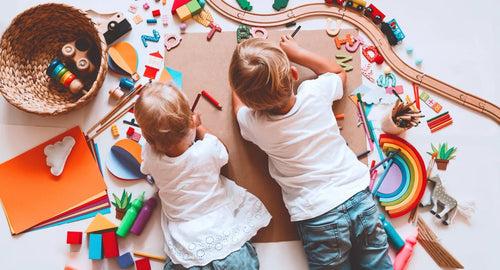
Facing a three-year-old who frequently says no and resists can make parents feel frustrated. But rather than getting stressed, this is when parents need to understand their child better and find a suitable approach.
Let’s pocket the scientifically grounded and nuanced tips for teaching a 3-year-old, helping parents stay calm and confidently accompany their child as they grow.
Why do 3-year-olds become stubborn?
A 3-year-old's brain develops very quickly, helping the child remember better, start to understand simple concepts and want to explore everything on their own. The child can run, jump, grasp, and try to do many things.
However, the desire for independence is not yet accompanied by the ability to actually do things. For example, when the child tries to put on a shirt but cannot, they easily become irritable or cry. This is when the "self" is forming, but language and skills are not yet enough to express and regulate emotions.

Tips for teaching a 3-year-old to be smarter and more responsive
Developing independence
Three-year-olds are eager to prove that they are grown up. A helpful tip for teaching a 3-year-old at this stage is to let them serve themselves, such as putting on shoes, washing hands, feeding themselves, choosing clothes, or putting away toys.
To increase engagement, parents can combine role-play toys such as kitchen toys, cleaning up, etc., helping the child play while naturally forming independent habits.
Kitchen toy sets at MyKingdom such as Giant 69-Detail Kitchen Set, Purple Hippo Oven Playset, etc., help the child play happily while practicing fine motor skills and forming habits of neatness.
Stimulating thinking and language through play
At age three, play is the child's most natural and effective way of learning. Use LEGO toys, puzzles, drawing, and coloring to train logical thinking. Use flashcards or songs to learn counting and recognizing letters.
In particular, continue the habit of reading ehon books, telling stories every evening, and asking open-ended questions to encourage the child to express thoughts and develop vocabulary.

Help the child express their emotions
According to Dr. Daniel J. Siegel, the right hemisphere of a young child's brain is highly active, while the left hemisphere has not yet developed enough to regulate.
When parents help the child express their emotions (using the language of the left brain), the two hemispheres connect, helping to soothe the child's aroused nervous system.
Rather than letting the child struggle with anger, parents can gently acknowledge: “I know you are very angry because the wooden tower fell, right?”. When the child understands that their emotions are acknowledged and respected, they will calm down and gradually abandon the habit of responding with shouting.
Give the child a choice
Rigid commands easily trigger defiance in children. Instead of ordering, give the child a choice such as "Do you want to wear the blue shirt or the red one?" The child will be eager to cooperate because they feel their voice is respected.
Additionally, parents can practice this decision-making skill through role-playing games, such as letting the girl choose her dress or brush the hair for her favorite doll.
And for boys, parents can let them decide which model car will head to the yard, or which superhero will go to save the world today.

Use positive language
Children are like mirrors reflecting how their parents communicate. Positive encouragement helps them become confident and obedient, while criticism or threats only make them feel inferior and more stubborn. Instead of saying: "Why are you so slow?", parents should encourage: "We believe you can do it faster and better!"
Stay calm and consistent
When a child throws a tantrum, properly ignoring them helps them understand that crying doesn’t yield results. Instead of letting the child deal with the anger alone, parents should provide tools to stay calm such as large-building-block construction toys or Play-Doh modeling clay made from child-safe materials.
This redirection will help the child momentarily forget the frustration, redirecting focus to creativity to regain joy and their inherent calm.
At the same time, parents need to set clear rules and maintain consistency to teach a 3-year-old more effectively. For example, if sweets are banned before bedtime, uphold the rule and explain gently so the child understands the limit and cooperates.
Redirect at the right moment
Instead of facing the child's anger head-on, parents should quickly redirect the child's attention to colorful toys. Colorful construction toy sets or musical toys will quickly engage the child, causing the anger to naturally fade.

Common mistakes that make teaching a 3-year-old more difficult
Sometimes, a stubborn child isn’t a personality trait but stems from adults' unintentional habits. Here are three mistakes parents should avoid:
-
Overusing electronic devices: Fast-paced videos reduce focus, making children irritable and resistant when interrupted. Parents should strictly control screen time
-
Diet rich in sweets: Eating many candies causes blood sugar to spike and crash, making children hyperactive and hard to regulate. Prefer a balanced menu, with Omega-3 and zinc.
-
Family lack of consistency: Parents set rules but grandparents spoil, creating gaps for children to dodge rules and develop a sense of entitlement. The family must absolutely align on a single set of rules so the child clearly understands the limits.

When should parents pay special attention?
Stubbornness is no longer a normal crisis if a 3-year-old shows the following signs:
-
Cannot yet say a short sentence of 3-4 words.
-
Rarely makes eye contact, few responses when called by name.
-
Exhibits repetitive self-harmful behaviors.
At this time, parents should take the child to a pediatrician or psychologist for timely intervention.

Raising children requires patience, consistency, and a positive environment. To maximize the effectiveness of these tips for teaching a 3-year-old and lay the foundation for the child to develop independence, parents can combine the use of educational toys and thinking exercises at MyKingdom, helping the child "learn through play, play through learning" every day.
See more
Habits of 3-year-olds that seem bad but are actually useful
Tips for choosing toys for a 3-year-old to develop superior cognitive abilities