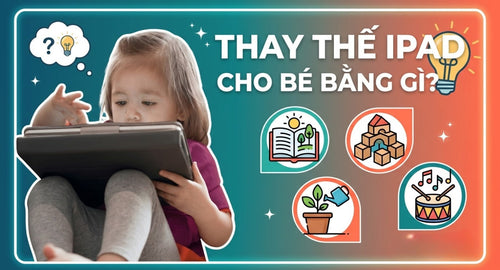
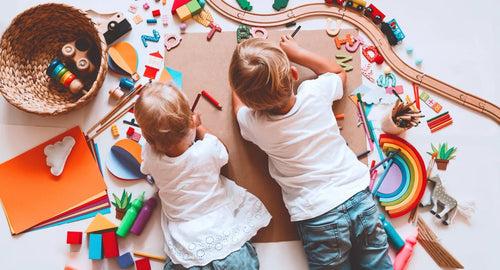
Watching your child all day wandering around toys and neglecting books, many parents can’t help but worry that their child will be distracted from learning. But, is play really opposite to your child’s progress? In fact, learning through play is what?
Let’s explore the method of learning through play—a gentle educational approach that helps children naturally absorb knowledge and turns each hour of play into a new opportunity for discovery.
What is Learning Through Play? Understanding it correctly to accompany your child without pressure
Concept of learning through play
Learning through play is a method that helps children acquire knowledge and develop skills through purposeful play activities.
Instead of passively receiving knowledge, children are directly encouraged to explore, experiment, ask questions, and find ways to solve problems during play. As a result, learning becomes natural, approachable, and more aligned with children’s exploratory needs.

How is learning through play different from free play?
During free play, the child freely releases energy according to instinct. But with the learning-through-play method, each toy or activity can offer a chance to explore and learn.
The child can count when stacking wooden blocks, or observe how a car moves when dropped from a height. The child still leads the activity, but the mind is expanding to absorb new lessons.

What benefits does learning through play bring to children?
The educational theories of Jean Piaget and Maria Montessori both emphasize the role of experience, activity, and children’s agency in the learning process.
When busy hands explore, children have the opportunity to simultaneously engage multiple senses, motor skills, and thinking to better understand the world around them.

Through these realistic interactive experiences, children have the opportunity to develop many important skills in five aspects:
-
Cognitive development: Learn to think logically, analyze the shapes and sizes of objects to independently find ways to solve problems.
-
Physical development: More dexterous hands from handling small objects (fine motor skills) combined with endurance through running and jumping activities (gross motor).
-
Language development: The child accumulates a rich vocabulary, learns to express thoughts and communicate more confidently when interacting with others.
-
Creativity encouragement: Freely soaring with self-created stories through a childlike lens.
-
Social and emotional skills: Overcoming small challenges hands-on helps the child learn to regulate emotions when faced with failure, thereby building daily perseverance.
5 factors that make learning-through-play activities effective
A successful learning-through-play activity typically encompasses five important factors:
-
Joy and enthusiasm: When children feel engaged, they tend to participate proactively and maintain focus longer in the activity.
-
Meaningful to the child: The play directly connects with what the child already knows, helping them gain deeper understanding of the surrounding life.
-
Child’s active participation: The child directly selects, manipulates, and makes decisions during play, rather than passively receiving content.
-
Encouraging exploration and experimentation: When a model collapses, the child learns to adapt, seek new solutions, and redo better.
-
Opportunities for interaction with others: Conversations and role-playing when playing with family help strengthen family bonds.

Common mistakes parents should avoid when letting children learn through play
Because of worry, some parents may inadvertently intervene too deeply in their child’s play, always imposing a “correct” outcome. When the child draws a blue elephant, the parent quickly corrects: "The elephant should be gray, dear." This unintentionally stifles the child’s creativity and autonomy.

In addition, time spent on electronic devices should be balanced with activities that involve movement, direct interaction, and hands-on experiences with real objects. Especially, direct play activities give children the opportunity to use their hands, senses, and interact with those around them.
Therefore, alongside books and digital devices, parents can add direct-play activities with toys, building materials, or exploratory tools suitable for the child’s age to best support the child.

Suggestions for learning-through-play activities with Mykingdom
Developing thinking and concentration with LEGO lines
In the early years, as children actively explore the world around them, colorful LEGO pieces will be wonderful companions to help them learn to focus.
Parents can easily offer variety with LEGO DUPLO blocks for younger children, the open creative world from LEGO Classic, or realistic models from LEGO City and LEGO Friends.

The diverse designs and the ability to assemble and disassemble multiple times let the child freely experiment, adjust, and create their own constructions. This is how they cultivate patience and naturally absorb geometric thinking.
Explore official LEGO sets at Mykingdom to create more opportunities for your child to assemble, test, and create.
Khi mở giao tiếp và trí tuệ cảm xúc cùng đồ chơi mô phỏng
When your child enters the babbling stage and enjoys imitating adults, vivid pretend-play toys will be perfect companions.
Pretending to be a doctor with a stethoscope to examine a stuffed bear, acting as a cheerful cashier tapping keys, or becoming a little chef preparing a warm dinner.

Each tiny detail with bright colors sparks curiosity, helping the child freely explore. Through these role-play moments, the child not only expands vocabulary and develops communication but also learns to care, share, and love those around them.
Explore lines of pretend-play toys suitable for each age at Mykingdom.
Awakening a love for science with creative STEAM toys
If parents want their child to approach mathematics or physics without dryness, smart STEAM toy sets are the ideal answer.
With thoughtful design from a reputable brand, every machine part, simple electrical circuit, or experimental tool is crafted intricately, stimulating vision and the child’s desire to explore with their own hands.

Through observation and experimentation, the child has the opportunity to understand scientific principles in a visual way, turning dry knowledge into engaging experiences.
Experience STEAM educational toy lines STEAM visually engaging at Mykingdom here!
Frequently asked questions about learning through play
Is learning through play about letting children play all day?
No. Learning through play is a way to leverage play activities to help children explore knowledge and develop skills. Parents still need to balance playtime with rest, physical activity, daily routines, and age-appropriate learning activities.
What ages is learning through play suitable for?
The learning-through-play approach can be applied across many ages, from early childhood to older children. The key is to choose activities with a level of challenge appropriate to the child’s abilities and interests.
How can parents apply learning through play at home?
Parents can start with simple activities such as assembling, building, role-playing, sorting objects, doing small experiments, or solving a challenge together with their child. Let the child actively explore and ask questions rather than providing ready-made answers.

Understanding what learning through play is helps parents shed worries and gently enter their child’s childhood world. Parents can explore educational toys, LEGO, and STEAM at Mykingdom to create more learning-through-play experiences that fit their child’s interests and age.
See more
Toy recommendations for educating babies from 0 to 6 years old
Top 6 mistakes when buying toys for babies that parents should avoid now