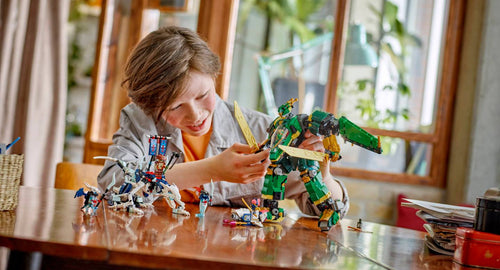
It's not true that simply buying a lot of expensive toys will make your child play with great enthusiasm. Toys only truly keep a child engaged when they are within the child's current abilities, and at the same time open up a fresh challenge for them to explore.
Choosing toys by developmental stage is the compass that helps parents clearly understand their child's needs at each age, from which they can select safe, useful gifts that accompany the child as they grow every day.
Why choose toys by developmental stage?
Every child grows at their own pace. Choosing toys appropriate for each age brings many practical benefits:
-
Support practicing skills at the right time: Children have the opportunity to practice the motor, sensory, language, and thinking skills that correspond to their developmental milestones.
-
Ensure safety for children: Help parents proactively avoid choking hazards for children under 3, while choosing sizes and materials suitable for their grasping ability.
-
Avoid waste: Toys that match their interests and abilities will be played with repeatedly rather than quickly left neglected.

Suggestions for choosing toys for children by age
0–12 months: Exploring senses and early motor development
In the early months, a baby's vision is still developing, and they are often drawn to high-contrast images.
The child gradually learns to listen to sounds around them, reach and grasp soft objects, and begins exploring the world by mouthing objects.

When they enter the sitting and crawling stage, they become curious about rolling and shaking movements and simple interactive reflexes
Suggested toy groups:
-
Stimulating vision and hearing: High-contrast picture cards, a music-playing play mat with soothing tunes or a rattle, a rattle with a soft handle.
-
Practicing grasping and soothing gums: A dedicated teething toy or a set of soft plastic block-shaped toys PEEK A BOO (PAB025) with embossed textures to help the child squeeze and explore safe tactile sensations.

Parents can also refer to safe newborn toys from Fisher-Price or PEEK A BOO to accompany their child in the first year.
1–3 years: Developing motor skills and imagination
From age 1, their motor skills become increasingly flexible: they stand more steadily, begin to walk, run, and eagerly explore their surroundings.
Their hands become more dexterous, vocabulary grows quickly, and they start enjoying observing and imitating familiar adult actions.

Suggested toy groups:
-
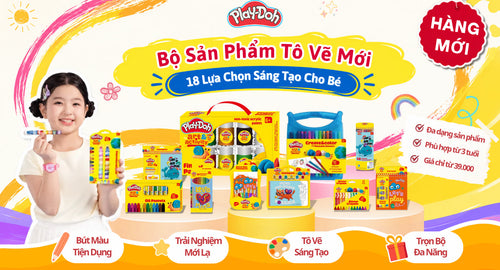
Developing fine motor skills of the hands: Soft Play-Doh helps the fingers get stronger through kneading, molding, and cutting shapes.
-
Getting acquainted with blocks: LEGO DUPLO bricks come in large sizes, fitting small hands, helping children learn to grip and assemble, with parents easily selecting according to the recommended age.
-
Early role-play toys: A set of kitchen toys, a doctor kit, or large-scale Siku model cars create opportunities for the child to practice forming complete sentences and imitate everyday situations.

4–6 years: Developing thinking and social skills
Entering the preschool years, their attention span extends. They start understanding simple game rules, know how to take turns, enjoy making friends, and are willing to share toys with others.

Suggested toy groups:
-
Spatial thinking and creativity: LEGO Classic sets or LEGO City open up space for the child to build houses and vehicles with their rich imagination.
-
Developing dexterity and patience: Craft toys, coloring materials, or puzzles help strengthen fine motor skills and introduce the essential skills needed before entering first grade.
-
Group interactive games: Simple board games like memory matching cards or rummy help children learn to follow rules and interact joyfully with friends.

6–12 tuổi: Exploring science and strategic thinking
In elementary school years, children have clearly developed logical reasoning, form specific personal interests, and enjoy challenging themselves through games with clear objectives.

Suggested toy groups:
-
Hands-on science (STEM): The STEAM 4M science experiment kit helps natural principles, energy or mechanics come alive and are easier to understand through the experiments children perform themselves.
-
Complex building models: LEGO Technic sets or engineering models require precision, helping children train sequential logical thinking and perseverance.
-
Family bonding board games: Classic games like Monopoly or Uno are wonderful opportunities for the whole family to gather on weekends, while helping children learn to calculate, plan, and handle situations flexibly.

What should parents pay attention to when choosing toys for their child?
-
Prioritize open-ended toys: Toys that are not restricted to a single way of play (such as building blocks, play dough) encourage children to freely experiment and create according to their own thinking.
-
Spend time interacting with your child: When playing with your child, parents have more opportunities to talk, ask open-ended questions, and listen to their expressions, thereby supporting the child’s development of communication and emotions naturally.
-
Check product information and origin: Parents should note the recommended age on the packaging, choose reputable brands with clear origins to ensure quality and a safe play experience for their child.

Choosing toys by developmental stage will help your child have enjoyable and beneficial playtime, unleashing their true potential at each age. Parents can visit the nearest store or refer to genuine toy lines at Mykingdom to easily choose the best gift for their beloved child.
Learn more
Should you buy toys for newborns? Important notes parents should remember
What should a 1-year-old play? Suggestions for smart and safe toys