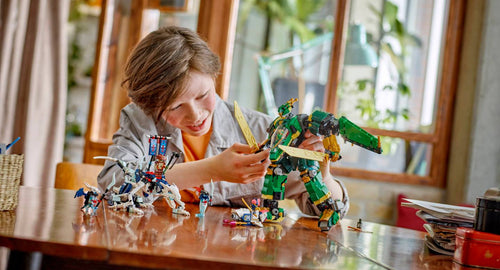
Have you ever sat beside your child feeling awkward about what to play, or puzzled when the little one only plays for a few minutes and then stops? In fact, kids don’t need elaborate activities or expensive toys.
Mastering the right way to play with your child will help parents confidently sync with their little one, turning every simple moment at home into opportunities for exploration and loving bonding.
Why is interaction during play important for a child’s development?
The concept of reciprocal interaction (serve and return)
Experts at the Harvard Center on the Developing Child liken the interaction between child and caregiver to a smoothly rallying game of tennis. The child "serves" with curious eyes, hand gestures, babble, or by offering a toy toward the adult.

When parents respond with eye contact, a smile, spoken words, or appropriate actions, the child feels the connection and gains additional opportunities to develop communication and language skills as well as social-emotional abilities.
Regularly maintained responsive interactions contribute to brain development and help build a strong bond between parents and child in the early years.
Prioritize interaction quality over simply counting playtime
Parents don’t have to spend hours continuously playing with their child. What matters is that during the available moments, adults pay real attention, listen, and respond to the child’s cues.

A few minutes together reading, talking, or assembling a small model with full concentration can also become a meaningful bonding experience.
Parents can weave these short interaction moments into daily routines, instead of pressuring themselves to play with their child for a fixed amount of time.
Four core principles to make playtime no longer a burden
Let the child lead the play (child-led play)
When adults respect the child’s ideas rather than imposing rigid play rules, the child gains more opportunities to explore, make choices, and express their creativity. Instead of constantly guiding the child to do this or that to be “correct,” parents can try playing the role of a listening, supportive friend.

Example: When the child holds a blue circular block and says, "This is a flying wheel!", instead of quickly correcting that a wheel cannot fly, parents can respond: "Oh, this wheel flies pretty high! Where is it taking you?"
Continuing the child’s story helps the child feel their ideas are valued and motivates them to share more enthusiastically.
Natural conversation instead of turning playtime into a test
Many parents accidentally turn playtime into a stressful test with a barrage of questions like: "What color is this?", "Can you guess what this is?"

To encourage natural language development, parents can refer to guidance from the United States Centers for Disease Control and Prevention (CDC) on positive communication:
-
Describe your child’s action: "The child is stacking these yellow blocks really high."
-
Emotional response: "It seems you’re a bit sad because the tower just toppled."
-
Imitate your child’s action: Together stack a similar block next to it or join in with your child’s toy-beating rhythm.
-
Ask open-ended questions when appropriate: "What do you think we could do to make that bridge stand more securely?"
Accept the mess to let your child feel free to experiment
Having a model built and then toppled or chalk marks not cleaned up is a natural part of the learning process. When parents encourage their child to try again rather than rushing to fix it, the child gains the opportunity to observe, find ways to fix things, and learn to stay calm when results aren’t as expected.
Parents can designate a corner of a play mat where the child can freely experiment without the family worrying too much about cleanup.
Help your child learn to handle winning and losing
When playing competitive games or family board games, parents don’t always have to let the child win. Play by the rules with your child, celebrate winning, and stay calm when losing.

If your child feels disappointed, you can acknowledge their feelings: "I know you’re sad you didn’t finish this round. Let’s try another game a little later."
Parents’ companionship helps the child understand that disappointment is normal, and also learn to regulate emotions and continue participating in the game after an outcome that didn’t meet expectations.
Suggestions for play ideas and toys suited to each development stage
Toys act as supportive tools, creating opportunities for parents and child to have more topics for conversation and interaction at home.
Stage 0 – 1 year: Awakening the senses and building initial connections
In the first year, a baby’s senses are developing daily through sound, high-contrast colors, and gentle movements.
-
Ways to play with your child: Play peek-a-boo, imitate the sounds the baby makes, name parts of the body, or gently clap along to a rhythm.
-
Recommended tools: Parents can choose a handheld rattle, crib-hanging toys, or a play mat suitable for the age (such as Fisher-Price products, Peek a Boo) for the baby to observe, listen to sounds, and practice with the hands. When allowing the baby to play, adults should check the toys are intact, follow warnings on the packaging, and always supervise the child throughout use.

Stage 1 – 3 years: Exploring shapes and refining fine motor skills
At this stage, the little hands are more dexterous, prompting the child to grasp, stack, and sort objects.
-
For children 1 – 2 years: Parents can play stacking large blocks together, playing with shape-sorting boxes, or rolling soft balls on the floor.
-
For children 2 years and up: Parents can consider Play-Doh sets labeled for appropriate age and with clear usage instructions. With the child, roll the dough into balls, press flat to make “cakes,” and name the colors—a fun activity to encourage tactile exploration and expand vocabulary.
(Safety note: Play-Doh is not edible. Adults should supervise to prevent the child from putting the product in the mouth and posing a choking risk; also check ingredients if the child has a history of wheat/gluten allergy).

Stage 3 – 6 years: Nurturing imagination through role-playing
Preschoolers often like to imitate adults and immerse themselves in imagined scenarios.
-
Ways to play with your child: Parents should join their child’s story: pretend to be a patient so the child acts as the doctor, or pretend to be a customer visiting your child’s bakery.
-
Gợi ý công cụ hỗ trợ: Parents can choose car models from SIKU or Hot Wheels with suitable age labeling, paired with kitchen or doctor playsets. Parents can set open-ended scenarios such as: "What do you think this truck is delivering?" or "Doctor, what should we do when our teddy bear hurts its paw?" to let the child freely lead the storyline.

Stage 6 years and up: Developing critical thinking and collaborative spirit
Older children are ready for games that require focus, careful observation, and patience.
-
Ways to play with your child: Read the instruction books together, classify puzzle pieces, and discuss how to handle misassemblies. This is also a good time for the whole family to play board games to train thinking and turn-taking.
-
Gợi ý công cụ hỗ trợ: Parents can choose LEGO City sets, LEGO Creator, or LEGO Technic sets with age recommendations appropriate to the child’s abilities. During play, work with the child to double-check steps when pieces don’t fit, encouraging the child to patiently find a solution rather than giving up quickly.

Unintentionally habits that reduce the quality of playtime at home
-
Half-hearted presence: Sitting beside your child but eyes still scrolling on the phone or handling unfinished work. Young children are very perceptive and will sense the adult’s distraction.
-
Doing everything for them for fear of getting dirty or breaking things: Rushing to do difficult tasks will unintentionally take away opportunities for the child to explore the feeling of overcoming challenges.
-
Constant interference and over-guidance: Bombarding with questions or forcing the child to play according to the adult’s preference will turn relaxation time into pressure. Allow the child to have moments to explore at their own pace.
-
Forcing the child to play with a toy they don’t like: Expensive toys do not automatically make the child enthusiastic. Parents should respect the child’s preferences at different times.

Frequently asked questions when guiding and playing with your child
If you’re too busy, how much time should parents spend with their child each day?
There isn’t a fixed number that suits every family. Parents can start with short, regular interactions and gradually increase focus during the day, then flexibly adjust according to the child’s age, interests, and state.
Is it worrisome if the child only wants to play a single activity repeatedly?
Not necessarily. Young children often enjoy repeating an activity because it helps them remember how to play, test new details, and feel familiar and secure. Parents can join by suggesting new scenarios, but there’s no need to force a change if the child is still having fun.

Ultimately, the most valuable toy for a child’s childhood isn’t the price printed on the box, but the warm presence and encouraging gaze of the parents. Understanding and applying the right way to play with your child will make every moment with your child more meaningful, a stepping stone to help them grow confidently day by day.
Parents can visit Mykingdom stores nationwide or visit the website to explore genuine educational toy lines suitable for the child’s age and interests!
References
-
Harvard Center on the Developing Child: Serve and Return Guide & Core Developmental Concepts
-
CDC (U.S. Centers for Disease Control and Prevention): Tips for Child-Led Play
-
CDC: Positive Parenting Tips – Praise, Imitation, and Description
-
AAP (American Academy of Pediatrics): The Power of Play: A Pediatric Role in Enhancing Development in Young Children
Image sources: Internet
Learn more
What should dad do when caring for a small child to make mom’s life easier?
What to do when parenting a tired child? 5 ways to help parents reduce pressure