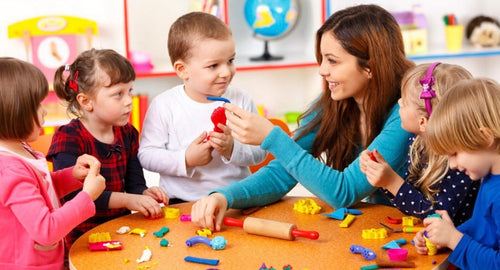
At the end of the day, many parents still struggle to find ways for their child to be less dependent on phones while staying enthusiastic about exploring, without the pressure of studying. Instead of turning playtime into dry lessons, nurturing children through the learning-through-play method (learning through play / play-based learning) encourages children to take the initiative to experiment and interact naturally.
When there are appropriate activities and the right parental guidance, every hour of play opens up opportunities for the child to develop many skills.
What exactly is the learning-through-play approach?
Many parents still wonder what learning through play is and worry that this method equates to letting children play freely without guidance.
In fact, the learning-through-play method is how children acquire knowledge and skills through playful activities, observation, handling, and experimentation, where the child retains agency while parents play the role of facilitators.

The table below helps parents clearly visualize the balance among the three common approaches:
|
Criteria |
Direct instruction-focused learning |
Free play |
Learning through play with guided exploration |
|---|---|---|---|
|
Child's role |
Receives guidance, follows instructions |
Takes the initiative to choose how to play and what they like |
Takes initiative to experience, experiment, and voice ideas |
|
Parents' role |
Guide, explain, support |
Prepare the space, observe when needed |
Play together, prompt but do not impose solutions |
|
Learning opportunities |
Access to specific knowledge or skills |
Explore interests and imagination |
Link knowledge to practice and problem solving |
|
Child's experience |
Depends on teaching style and level of suitability |
Has space for autonomy, freedom to choose |
Combines initiative, interaction and learning goals |
What benefits does learning through play bring to a child's development?
According to Global Report on Early Childhood Care and Education, a synthesis by The LEGO Foundation drawing from more than 300 studies worldwide shows that learning through play has a positive link to the development of cognitive, social, emotional, physical, and creative skills in children.
In addition to skill value, hands-on play activities are also a way for families to balance screen time.

According to Guidelines for physical activity to promote community health (Department of Disease Prevention – Ministry of Health, 2026), one-year-olds are not encouraged to enjoy screens; children aged 2 to under 5 should limit this time to no more than 1 hour per day, the less the better.
Instead, young children need many opportunities for movement and direct interaction throughout the day.

5 meaningful characteristics of learning-through-play activities
According to the Learning Through Play framework as described by The LEGO Foundation and UNICEF, when teaching children at home through learning-through-play, parents can apply the following five characteristics:
-
Fun: Create a comfortable atmosphere for the child to eagerly explore; even if there are small challenges, children are encouraged to find solutions.
-
Meaningful: Link play to everyday life such as counting treats when dividing portions, sorting objects, or role-playing buying and selling.
-
Active participation: Prioritize activities that encourage the child to manipulate things, choose, and think instead of just watching.
-
Experimentation and adjustment: When the toy tower falls, let the child try a different arrangement or reinforce the base before adults help.
-
Social interaction: Playing with parents or friends helps the child learn to exchange ideas, take turns, share, and recognize emotions.

Suggestions for learning-through-play activities by age
To tailor playtime to the child's developmental needs, parents can choose activities based on the recommended age, the child's interests, and abilities.
Stage 0–2 years: Sensory exploration and movement
In the early years, the child explores the world through looking, touching, and grasping objects. Parents can choose age-appropriate thinking development toys and always supervise the child during play.
Fisher-Price Mattel FFC84 Shape Sorting Blocks toy (from 6 months old and up) is a suggestion for this stage. The product set is battery-free, includes 10 colorful blocks and a container with holes to practice grasping, turning, and dropping pieces into place.

Stage 3–5 years: Creativity, role-play, and construction
As they reach preschool age, children enjoy asking questions, imitating adults, and telling stories using imagination. When applying early education through play, parents should prioritize "open-ended" toys that allow children to mold or rearrange in many ways.
For sculpting activities, Play-Doh modeling clay in a 4-color set B5517 (from age 2) helps children knead, press, and roll into a cake or cute animals.
According to Hasbro, the product's main ingredients are water, salt, and flour; parents should ensure the child plays at the appropriate age, avoid eating the product, and check for wheat allergy in the child.

Additionally, LEGO DUPLO sets with large bricks and many preschool-themed themes (selected according to the recommended age on the box) allow the child to build houses, vehicles and then role-play with parents, tell stories.

Stage 6–10 years: Logical thinking, problem solving, and games with rules
When entering elementary school, children begin to be ready for challenges requiring reasoning, planning, and following rules. Because a 6-year-old's abilities differ considerably from a 9–10-year-old, parents should choose games with gradually increasing difficulty according to the manufacturer's recommendations.
For children who like building, from age 6 they can start with LEGO City or LEGO Creator sets (many models recommended for 6+) to get used to multi-step instructions.

As they grow older (7+ and up) and want to learn about machine construction, the LEGO Technic line with gears, axles, and moving mechanisms will provide an interesting experience of observation and self-adjustment.

On weekends, the whole family can play age-appropriate board games: children starting at age 6 can begin with Guess Who? F6105 (guess the character through yes/no questions), while kids 8 and up who are ready for math and longer rules, Monopoly Basic G0009 will be the next choice to practice calculating, taking turns, and group communication.

How should parents accompany their child when playing?
Many busy parents often hesitate to find ways to play with their child because they worry there isn’t enough time. In reality, parents can start from short periods that fit the family schedule, for example 15–20 minutes when convenient—what matters is presence and listening to the child during play.

Rather than stepping in to help or pressuring the child to answer correctly, parents should observe and prompt when needed, for example, "How can we make this tower stand more firmly?" Sometimes, simply trying a new idea together or letting the child lead the story also creates meaningful interaction.
Besides, parents can display a manageable amount of toys to help the child focus, store the rest, and rotate when the child is less interested; when buying new, prioritize products with clear origin, appropriate age range, and multiple ways to play.

Frequently asked questions about the learning-through-play method
Will a child applying the learning-through-play method have gaps in knowledge when entering first grade?
No. Through age-appropriate activities, the child still becomes familiar with letters, numbers, and language, while also training observation, communication, and maintaining enthusiasm for learning without pressure.
How can a child be motivated to clean up toys after playing?
Parents can turn tidying up into a small game such as finding the right box, sorting by color, or counting how many items have been put away, maintaining consistency with simple requests so the child gradually becomes proactive.

Childhood is not a race to run ahead of the curriculum, but a precious time for children to explore and nurture a love of learning. When parents provide their child with activities of the learning-through-play method that are suitable and accompany at the right moments, each small experience contributes to the child's development.
Parents can refer to lines of construction toys, creative toys, and family board games at Mykingdom to find activities suitable for the child's age and interests. Visit the Mykingdom store or browse the website to explore more!
See more
What is learning through play? Secrets to helping your child develop comprehensively
Tips to help your child develop comprehensively at home through each hour of play